 Lobobase
 Prices in USD and EUR
Lobobase prices in USD and EUR express the value of LOBO, its Base memecoin, in different currencies. Changing that display leaves the number of tokens unchanged. When both figures use the same token price and observation time, the exchange rate explains their currency difference. Neither denomination promises a working buying or selling route. The tracked market listing reports stopped trading across its covered exchanges and shows no active pairs, even though it retains price fields.
A euro valuation does not establish euro sale proceeds, especially when the tracked LOBO listing shows no active trading pairs.
USD and EUR as units of value
A USD price states a value in US dollars, while a EUR price states a value in euros. Each figure answers how much one LOBO token represents in the selected currency. The currency code belongs to the valuation; LOBO remains the token that the figure describes.
USD provides a common unit when the other values already use US dollars. EUR supports a comparison with amounts expressed in euros. Neither choice makes the underlying token more valuable merely because one display contains a larger number. Comparing those raw numbers directly leaves their different units out of the calculation.
The balance behind a portfolio valuation
A LOBO balance counts tokens, while its fiat valuation combines that count with a price in the chosen currency. The value of a LOBO holding equals its token quantity multiplied by the price per token in the selected currency.
Using the same balance with a euro price produces a euro valuation. Using it with a dollar price produces a dollar valuation. Neither calculation transfers tokens or converts them into bank money. An actual sale would require an available market and its own execution terms.
The exchange rate connecting equivalent prices
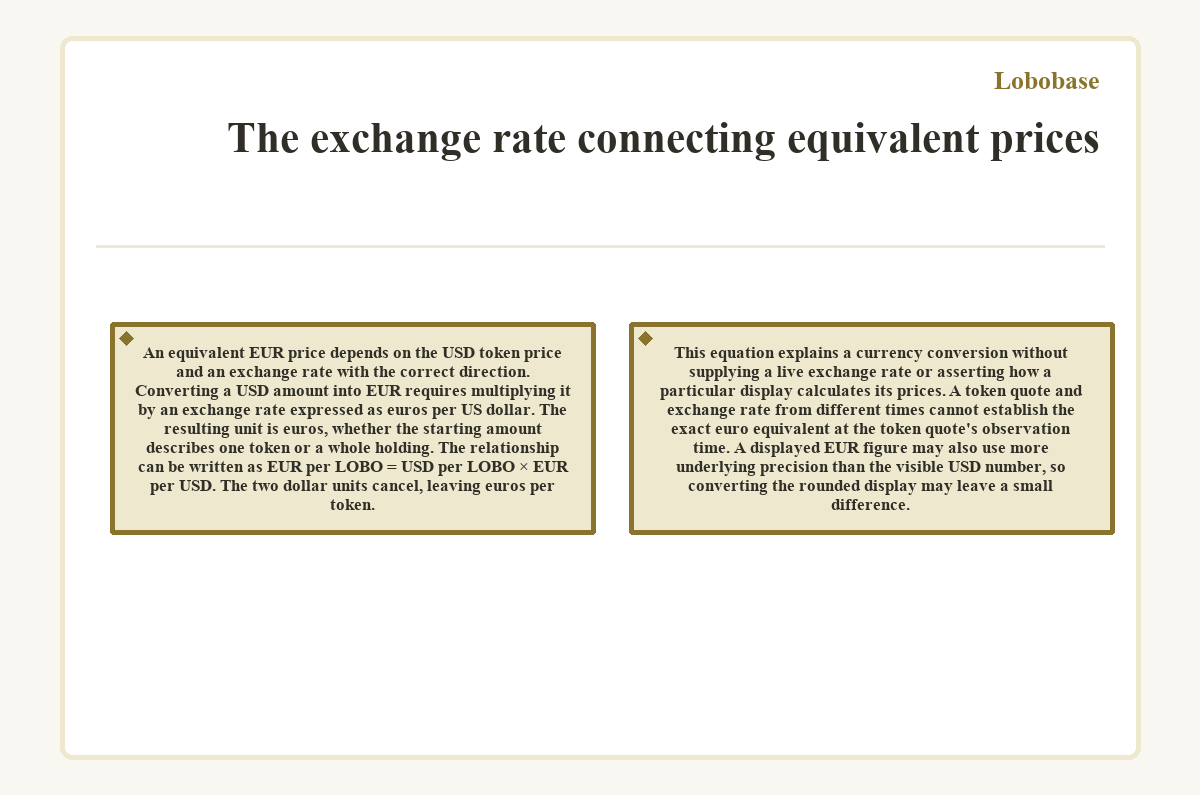
An equivalent EUR price depends on the USD token price and an exchange rate with the correct direction. Converting a USD amount into EUR requires multiplying it by an exchange rate expressed as euros per US dollar. The resulting unit is euros, whether the starting amount describes one token or a whole holding.
The relationship can be written as EUR per LOBO = USD per LOBO × EUR per USD. The two dollar units cancel, leaving euros per token. This equation explains a currency conversion without supplying a live exchange rate or asserting how a particular display calculates its prices.
A token quote and exchange rate from different times cannot establish the exact euro equivalent at the token quote's observation time. A displayed EUR figure may also use more underlying precision than the visible USD number, so converting the rounded display may leave a small difference.
Token details shared by both denominations
Both currency views concern the same asset when they identify the same LOBO token on the same network. The LOBO token associated with Lobobase belongs to the Base network. A currency selector changes the unit used for its value; it does not select another network.
| Parameter | Listed value | Meaning | Effect of currency selection |
|---|---|---|---|
| Token ticker | LOBO | The token symbol | The ticker stays LOBO |
| Network | Base | The token network | The network stays Base |
| Dollar denomination | USD | US dollars per LOBO | The display uses dollar units |
| Euro denomination | EUR | Euros per LOBO | The display uses euro units |
| Trading pairs in the tracked listing | None shown | The listing identifies no active pair | Does not confirm a trading route |
Does a EUR display establish a euro trading pair?
A EUR display does not establish a LOBO market that accepts euros as the asset exchanged for tokens.
A converted price expresses a token value in a familiar currency. A trading pair identifies the assets that a particular market exchanges. The same distinction applies to a USD label: it identifies a valuation unit without documenting a dollar-funded purchase route.
The tracked LOBO listing reports stopped trading across its covered exchanges. Its market section also shows no active pairs, despite the price and volume fields that remain elsewhere in the record. Those fields cannot establish an executable route.
This reported status applies to the markets that the listing covers. It does not establish whether every possible venue has stopped trading.
The retained volume field describes reported activity over its measurement window. It supplies no confirmation of an executable order in either currency.
Precision at small token prices
Rounding changes the visible precision of a price, while currency conversion changes the unit in which that price appears. These effects can occur together. When a token price uses many decimal places, rounding each currency view separately can make the displayed figures look less closely related than their underlying values.
A calculation that starts with a rounded unit price also carries that rounding into the holding value. Multiplication spreads the per-token rounding difference across the token quantity. This explains why a displayed portfolio total need not match a calculation using only the shortened price on screen, even when both use the same currency.
Price movement in the chosen currency
LOBO performance measured in EUR can differ from performance measured in USD because the exchange rate can change during the measurement period. A comparison therefore needs matching start and end points, alongside the currency denomination.
For equivalent observations, a euro-denominated return combines the dollar token-price change with the change in euros per dollar. The growth factors (one plus each return expressed as a decimal) multiply across the interval; simply adding the percentage changes leaves out their interaction. An unchanged USD valuation can therefore coexist with a changing EUR valuation. Neither observation, by itself, describes a change in the number of tokens held.
Market cap on the same currency basis
Market capitalization uses the currency of the token price that enters its calculation. Market capitalization equals the token price multiplied by its circulating supply. A USD token price produces a USD market cap. Applying an equivalent EUR price to the same circulating supply produces a EUR market cap.
The underlying token supply remains a count of LOBO units. Currency conversion does not change that count or resolve questions about which tokens belong in circulating supply. It also does not turn market capitalization into available liquidity. A unit price and a market cap measure different quantities, even when both use the same currency.
Displayed value and possible sale proceeds
A holding valuation estimates value at a stated unit price; sale proceeds depend on the trade that actually executes. An execution price can differ from the unit price used in that valuation. Any fees that apply to the actual route also affect the net proceeds. The selected display currency does not establish those terms.
For LOBO, the absence of active pairs in the tracked listing prevents its retained figures from confirming a sale through those listed markets. A euro valuation also does not establish that a sale would deliver euros. The asset received depends on the actual trading pair. Receiving another currency requires a route that supports that currency.
Observations that can be compared directly
A useful USD-EUR comparison keeps the token identity, observation time and measurement period consistent. Different timestamps can mix token-price movement with exchange-rate movement. A current-looking currency label does not establish when the underlying quote last changed, especially when the listing reports stopped trading. Precision matters too: two rounded figures can differ from a conversion that uses their full underlying values.
The currency that fits the comparison
USD and EUR each work as valuation units when the other amounts in the comparison use that same currency. Keeping one unit throughout makes a token price, holding value and market cap easier to interpret together. The token count remains a separate quantity.
Choosing a familiar unit can make a value easier to understand, while market availability still determines whether a trade is possible. Neither denomination improves liquidity or establishes proceeds from a sale. The choice concerns how to express the valuation: US dollars under USD or euros under EUR.
Lobobase questions, answered
-
Can I convert a total LOBO valuation without knowing the token count?
- A total LOBO valuation in USD can be translated into EUR using an exchange rate from the valuation's observation time, expressed as euros per dollar. The token count is unnecessary when the starting figure already represents the whole holding. That translation carries forward the original valuation's timing and limitations; it does not establish sale proceeds.
-
How should I use an exchange rate quoted in dollars per euro?
- Divide the USD valuation by an exchange rate expressed as US dollars per euro to obtain EUR. Multiplication would apply when the rate instead expresses euros per dollar. The direction of the rate changes the operation, so a currency pair's label needs its accompanying unit convention.
-
Is the dollar symbol enough to identify a USD valuation?
- The dollar symbol alone does not uniquely identify US dollars. An explicit USD code identifies the intended denomination more precisely. For a currency comparison, the code and the unit price belong together; an amount without a clear currency cannot establish an equivalent euro value.
-
Will a fixed exchange rate preserve LOBO's percentage price change?
- Applying one unchanged exchange rate to both endpoints preserves the percentage change between those prices. The common conversion factor cancels in the ratio. Using each endpoint's own changing exchange rate can produce a different EUR percentage change, even when the underlying USD price observations remain the same.
-
When would LOBO's USD and EUR historical peaks occur at different times?
- Historical peaks can occur at different times when exchange-rate movement changes which observation has the highest value in each currency. Each historical conversion requires the rate applicable to that observation. Converting a USD peak with a later exchange rate does not establish the historical EUR peak.
-
What happens if I add USD and EUR valuations for the same LOBO holding?
- Adding the two valuations counts the same holding twice and also mixes currency units. They are alternative expressions of one holding's value. A combined total for distinct holdings needs a common currency basis, while each holding should contribute its value only once.
-
Can a EUR valuation alone reveal profit on a LOBO holding?
- A EUR valuation alone does not establish profit because it contains no acquisition cost. A profit calculation needs the holding's relevant cost expressed on a consistent currency basis. For a completed sale, the proceeds and applicable fees enter that calculation.